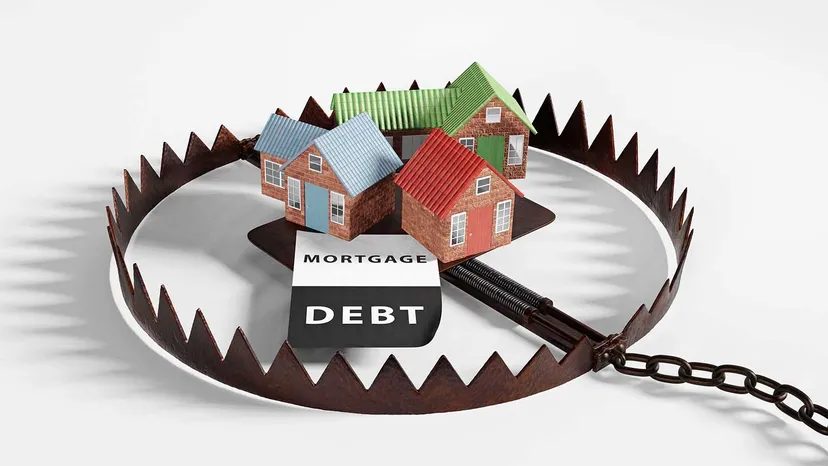
The American dream of homeownership isn’t what it used to be. Sure, everyone wants the white picket fence. But the housing market in the U2000s proved that the dream can turn into a nightmare pretty fast. We saw a massive boom and then an even more massive bust. What caused it? Tricky lending programs. Specifically, subprime mortgages.
These loans let people with shaky credit get into the market. That sounds helpful. It also helped crash the economy.
What Is a Subprime Mortgage?
First, clear up a common misconception. “Subprime” doesn’t refer to the interest rate. It refers to the borrower’s credit rating.
If your credit score is below 620 on that 300-to-850 scale, you are likely in the subprime category. Most people sit in the mid-600s or 700s. During the boom, though, lots of people who could have qualified for a standard loan took subprime ones instead. Why? Aggressive mortgage brokers. They approved loans too easily. They didn’t explain the stricter repayment terms. They just wanted the commission.
Subprime lending started ramping up in the mid-1990s. By 2006, these loans made up about 20 percent of all home loans. That is a huge chunk of the market.
The upside? People with bad credit finally had a door open. The downside? These loans default more often. When borrowers can’t pay, the house gets foreclosed on. Those foreclosures hurt everyone. Lenders went under. The economy took a hit.
There is also the issue of predatory lending. This is where lenders target minorities. They prey on inexperience. They might overvalue your property. They might lie about your income or credit score just to charge you a sky-high rate. They push frequent refinancing too. They roll closing costs into the loan so you owe more later. It is a trap.
How Subprime Loans Are Structured
Subprime mortgages come in many shapes. The one constant? The interest rate is higher than the Federal Reserve’s prime rate. The prime rate is what good-credit borrowers get.
The most common type is the Adjustable-Rate Mortgage, or ARM. These were huge during the boom. Why? Low initial monthly payments. Low intro rates.
Introductory rates usually last two or three years. Then the rate adjusts every six to twelve months. Payments can jump by 50 percent or more. You might hear terms like “2/28” or “3/27.” The first number is years at the intro rate. The second is years with the fluctuating rate.
Some subprime ARMs have interest-only periods. This means your early payments go only to interest. Not the principal. Let’s look at a 2/28 interest-only ARM.
You pay only interest for the first two years. The rate is lower. After that, the full loan amount is recalculated over the remaining 28 years at a new, higher rate.
The Math Behind the Risk
Investopedia has some stark examples. Let’s say you buy a $350,000 home. You put down $50,000. You need a $300,000 loan.
If you take a 2/28 ARM at 5 percent interest:
– Monthly payment starts around $1,900.
– Include taxes (~$230) and insurance (~$66).
– Total monthly cost is roughly $2,196.
If the rate stays at 5 percent for two years, then ticks up to 5.3 percent, your payment goes to $1,961. Then it adjusts every six months. Usually up.
Now compare that to a 30-year fixed-rate mortgage. Same loan amount. Same 5 percent interest. You pay $1,906 per month indefinitely.
The fixed rate is cheaper from day one and stays there. The ARM starts slightly higher with fees but seems attractive because of the initial structure. But that stability is gone after the intro period.
Can You Refinance Out of It?
You might think you can just refinance after the two years. During the housing bust, that was nearly impossible. Home values dropped. You couldn’t refinance if you owed more than the house was worth.
Even if you could refinance, you pay new closing costs. Every time you refinance, the lender gets paid. You get stuck with more debt.
Other Hidden Costs
Subprime loans often include prepayment penalties. If you pay off the loan early, you owe extra fees. They don’t want you leaving.
They might also include a balloon payment. This is a large final payment due at the end of the loan term. It is intentionally larger than previous payments. You need to be ready for that hit.
Who Qualifies?
Credit score isn’t the only factor. Lenders look at everything.
- Proof of income and assets.
- Debt-to-income ratio.
- Borrowing a large percentage of your income.
If you can’t prove you can pay, you are risky. Even with good credit. The lender sees a red flag.
This is just the beginning. We will look at specific examples next to help you decide if a subprime mortgage is right for you. Or if you should walk away. Because walking away might be the smarter move.
“Subprime generally refers to the credit rating of the borrower, not the interest rate.”
The key is knowing what you are signing. The numbers on the page tell a story. Read it carefully.
How NeighborWorks Helps Borrowers Avoid Foreclosure
Not every outcome of the subprime lending collapse was a total loss. One group, NeighborWorks America, is working to fix the damage. They have a Mortgage Relief & Foreclosure department that trains counselors. These pros help borrowers figure out their options before it’s too late.
They stepped in because communication broke down. When borrowers ran out of money, they stopped talking to their lenders. Shame or fear kept them quiet. Lenders couldn’t find them either. Both sides sat on their hands. Actions to prevent foreclosure existed. No one took them.
The Numbers Behind the Collapse
Defaults exploded in 2006. The subprime mortgage crisis was no longer a warning; it was the reality. By July 2008, the data was grim. One in five subprime mortgages were delinquent. Adjustable-rate mortgages (ARMs) were worse. Twenty-nine percent were seriously behind.
The financial bleed was massive. Stock market paper losses hit $7.4 trillion. Real estate wealth vanished by about $3.4 billion. People lost homes. Investors lost portfolios.
Who Bears the Blame?
It wasn’t just one party. Several factors collided.
Mortgage brokers played a big role. In the past, you went straight to the bank. Then brokers became the go-betweens. They weren’t directly accountable when loans went bad. It was a commission-based industry. If a loan defaulted, the broker didn’t pay a penalty. There was no incentive to say no. They steered clients toward loans they couldn’t afford.
Unemployment made it worse. Midwestern states hit by auto industry layoffs saw high foreclosure rates. People hoped to refinance. Housing appreciation slowed down. Refinancing became impossible. When the introductory rate on subprime loans expired, payments spiked. Many couldn’t handle the new cost.
Borrowers also share responsibility. Credit was easy to get. Many didn’t read the fine print. They took risks they couldn’t afford. They signed away their security without looking closely at the terms.
The Racial Disparity in Lending
Another dark side of the crisis involved minorities. Lenders exploited communities to get rich. The Home Mortgage Disclosure Act (HMDA) of 1975 required lenders to track and disclose loan data. The numbers showed stark differences along racial lines.
Black and Hispanic borrowers received subprime loans at much higher rates. In 2006, the gap was huge. Fifty-three percent of Black borrowers had subprime mortgages. Only 17 percent of whites did. That is a 36 percent difference.
A 2006 study by the Center for Responsible Lending (CRL) dug deeper. They looked at equal credit risk. Even when risk was the same, Black borrowers were 31 to 34 percent more likely to get a higher interest rate than whites. The system was rigged.
Subprime Mortgages FAQ
What is the subprime mortgage crisis?
Banks needed to fill demand for mortgage-backed securities (MBS). They offered unsafe mortgages to people who couldn’t keep up with payments. Home prices dropped. Foreclosures skyrocketed. The securities failed.
Are subprime mortgages back?
Sort of. They are called “non-prime” mortgages now. They are gaining popularity again. But the rules are stricter. You need better proof of payment.
Do subprime loans hurt your credit?
Yes. Any loan can damage your score. It happens if your loan-to-income ratio is too high. It also happens if you miss payments.
Who caused the subprime mortgage crisis?
Multiple bad actors. Predatory lenders offered mortgages to people who couldn’t repay them. Credit rating organizations ignored the risks. The mortgage-backed security industry failed to regulate itself.
Why is subprime lending considered bad?
These loans go to people less likely to make payments. Lenders charge higher interest rates to offset that risk. Higher rates make the loan even harder to repay. It creates a cycle of debt.