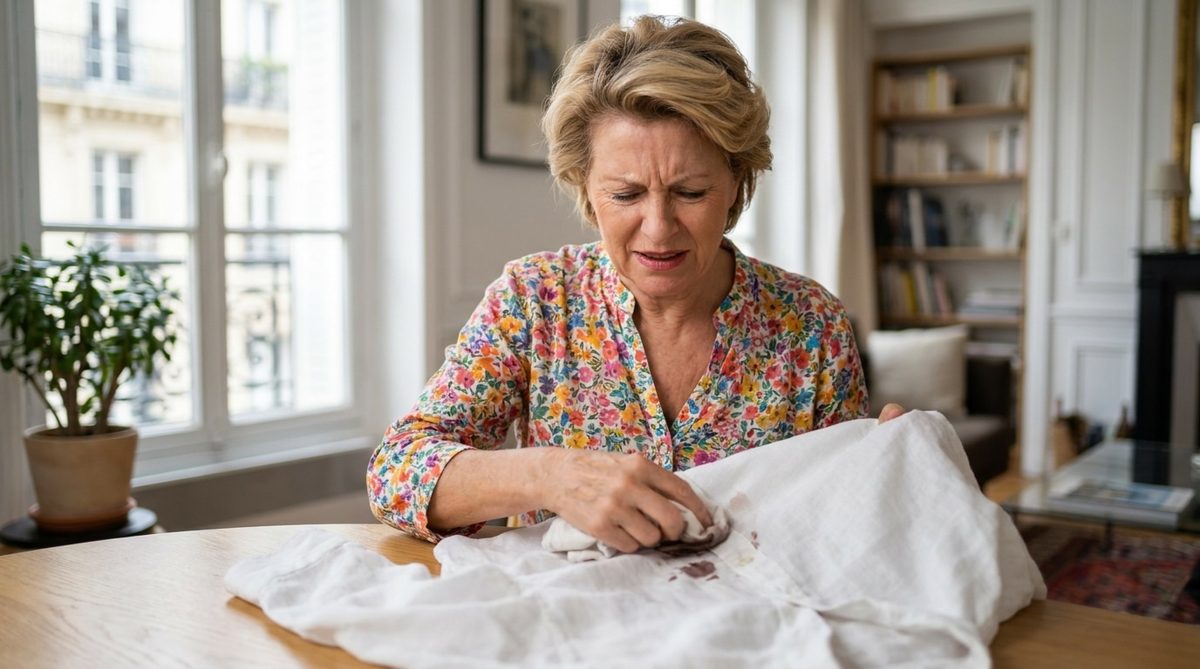
You think speed is your friend when a red wine glass tips over at dinner. You grab salt. You pour water. You rub frantically.
Wrong.
This instinctive rush is why that “quick fix” becomes a permanent stain. We imagine we are saving the shirt. In reality, we are often locking the pigment into the fabric fibers. A stain isn’t just a mess; it’s chemistry. It involves pigments, proteins, and fats. Treating it randomly is how you guarantee failure.
Here are the three biggest DIY laundry mistakes that turn a minor accident into a ruined garment.
Salt on Wine Stains: The Myth of Absorption
Let’s clear this up once and for all. Putting salt on a red wine stain is one of the oldest myths in the book. It feels logical. Salt absorbs moisture, right? Like an sponge.
No.
Salt does not absorb wine like a sponge. In fact, salt acts as a mordant. In textile dyeing, salt is used to help pigments bond securely to the fiber. By pouring salt on fresh wine, you might be accelerating the process of the color anchoring itself deep into the cotton or linen.
The result? The stain sets faster. The surrounding fabric may even weaken or discolor, leaving a stubborn halo that is nearly impossible to remove.
The better approach:
Do not rub. Rubbing spreads the wine. Instead, use this method:
- Blot, don’t rub. Use a paper towel or clean cloth to press against the stain. Lift the liquid away.
- Dilute. Once the excess is gone, use carbonated water (sparkling water) to tamp the stain. The bubbles help lift the pigment.
- Alternative: If you don’t have soda, warm milk can work on some textiles, or a mix of warm water and Marseille soap.
- Rinse. Always rinse thoroughly so the cleaning agent doesn’t dry in the fiber.
Change your cloth frequently. Don’t smear the wine into a larger area.
Hot Water on Protein Stains: Cooking Your Shirt
Blood. Egg. Mayonnaise. Dairy products.
These all share one thing in common: Protein.
When you hit protein with heat, it coagulates. It cooks. If you pour hot water on a blood stain or egg spill, you are essentially scrambling the protein inside the weave of your shirt. It binds to the fibers as hard as if you had baked the fabric in an oven.
This creates the “phantom stain.” You wash it out. You think it’s gone. You dry the shirt. Then, a beige or grayish mark reappears once it dries. It’s there to stay.
The fix is counter-intuitive:
Use cold water. Immediately.
If the stain is fresh, an ice cube wrapped in a clean cloth can help dissolve and loosen the protein without setting it. Wash in cold water. If the stain persists, do not switch to hot water. Repeat the cold pre-treatment.
Rule of thumb: As long as the stain is visible, keep the heat away. Even if you are in a rush to wear the item, heat is the enemy.
Heat: The Point of No Return
The moment a stain becomes permanent is often the moment heat is applied incorrectly.
Ironing. The dryer. Hot water.
If you put a garment with a remaining trace of stain—tomato sauce, fruit juice, grease, makeup—into a dryer or under an iron, you are sealing it. The heat fixes the majority of common stains. It fuses them to the textile structure.
This also changes the fiber itself, making subsequent attempts to remove the stain far less effective. You might see the stain vanish while the fabric is wet. The moment it dries? It reappears, darker and more defined.
How to avoid the trap:
- Inspect systematically. Check the garment in daylight after washing. Don’t trust your gut. Look for shadows or tints.
- Stop the process. If you see anything, do not put it in the dryer. Do not iron it.
- Re-treat while wet. A second spot-treatment on damp fabric is more effective than fighting a dry, set-in stain.
- Air dry. If you are unsure, lay it flat to dry away from direct heat. This buys you time to treat the stain again.
The dryer is a final verdict, not a second chance.
You’ve handled the basics. But there are other stains that require specific chemistry. Things like grease, ink, or old sweat don’t respond to cold water and salt.
We’ll get into those next. For now, stop cooking your clothes.
Why scrubbing and bleach ruin your laundry
You see a coffee spill. Your instinct kicks in. You grab the sponge and scrub like your life depends on it.
It’s a classic mistake.
Scrubbing doesn’t lift the stain. It drives it deeper.
When you apply aggressive friction, you aren’t removing the pigment. You are forcing it into the heart of the fabric. The fibers get damaged in the process. You might end up with a faded halo or a rough, worn patch that looks worse than the original spill.
The fix is boring. But it works.
Dab.
Use a clean cloth. Press gently from the outside edge toward the center. This stops the spread. Replace the dirty part of your cloth often. It’s slow. It’s less dramatic. But it actually removes the matter instead of burying it.
Then there is the bleach trap.
Specifically, using chlorine bleach on white shirts with sweat or urine stains. It seems logical. Yellow sweat stains need whitening, right?
Wrong.
Chlorine reacts with the proteins and salts in sweat. The result? A bright, permanent yellow fix. It acts like a chemical burn on the fabric. Once that yellow sets, it is nearly gone to keep.
For body stains, skip the harsh chemicals.
Use white vinegar as a pre-treatment. Make a paste with baking soda. Or reach for sodium percarbonate. It is especially effective on whites and safer than chlorine.
Here is the rule of thumb:
If the stain is “bodily” (sweat, urine, blood, egg proteins), avoid aggressive cleaners. Use cold water. Use gentle methods. Wash appropriately.
Heat is another enemy.
Hot water sets protein stains like blood and egg. Ironing or tumble-drying before the stain is gone “cooks” it into the fiber. Once heat hits a set stain, it is often indelible.
So many stains become permanent not because of the accident. But because of the reflex.
Salt on red wine? Sometimes helps, sometimes hurts depending on timing.
Hot water on egg? Disaster.
Intense scrubbing? Bad.
Bleach on sweat? Permanent yellowing.
They all share one trait. They fix the stain instead of removing it.
Adopt slower, cooler, more methodical habits. Most textiles can be saved if you stop trying to force them.
Before you reach for the spray or the brush, ask yourself one thing.
Are you extracting the stain or cooking it into the fabric?


