Stop buying ice and stop relying on the grid. The idea of giving up the usual use of a refrigerator feels like a step back, like going back to the 19th century. But this is not the case. This is actually a response to a bigger problem. Two billion people on Earth have no electricity at all. For them, preventing food spoilage is a daily struggle. What about the rest of us? Traditional refrigerators consume a lot of energy. It plays in the background and its power consumption increases rapidly.
There is a better way. You don’t have to live in the Dark Ages to save the planet. It is enough to observe how the sun works.
How solar energy really works
Let’s clear up the terminology first. Photovoltaic (PV) is the technology behind solar panels. You’ve probably seen them on rooftops, tents, and even the International Space Station. They are everywhere because they work.
This is simple physics.
1. Sunlight hits the solar cell.
2. Heat loosens the electrons in the battery.
3. These free electrons produce an electric current.
The flow is beautiful. It is playable. It can make the refrigerator more efficient.
SunDanzer: Space technology for the kitchen
SunDanzer is one of the most recognized brands in this industry. Licensed by NASA. Why? That’s because the technology inside it was developed for the International Space Station.
This is not a toy. Adopts standard cooling mechanism. compressor. coolant. work. The difference is the power supply. Instead of plugging into the wall, the SunDanzer plugs into your solar panel. Solar energy is used as a power source for the cooling system.
This works well. You can count on it. This completely solves the network dependency problem.
Another option: passive cooling
But SunDanzer is just one of them. There is another approach that is gaining traction. An energy source that uses “solar energy” in a simpler and more primitive way. No complicated electronics. The battery does not deteriorate.
The next section explains how SunDanzer actually works in a real home environment. Next, we’ll look at a simpler, passive option that may be just what you need.
Why bother with solar cooling?
You may be asking yourself if this is worth the investment. The answer depends on where you live. If you live in an area with frequent power outages, a solar-powered refrigerator is your insurance. If you want to reduce your carbon footprint, act directly.
Traditional refrigerators work 24/7. It turns on and off, but always consumes power. Solar installations change this equation. When used, electricity is generated. There is no transmission loss. Our remote factories do not use fossil fuels.
“Solar panels are installed on buildings, homes and tents to power cell phone chargers, radios and the International Space Station.”
NASA contact information
SunDanzer didn’t come out of nowhere. It is based on technology designed for space. The International Space Station requires reliable cooling. I can’t stand failure. The same strict requirements apply to the kitchen.
When you buy SunDanzer, you buy it
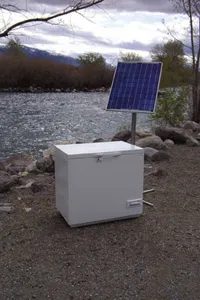

Why #NASA scientists are developing solar-powered refrigerators for Earth
Remote research station. Eco resort. Food trucks stood in the busy market. Or a hunting lodge that the net never reaches. In places with little or no electricity, staying cool is more than just a convenience. It’s about safety. Fresh food can spoil. The medicine loses its effectiveness. Vaccines are useless.
This realization led two NASA scientists to work on the International Space Station’s cooling system. They study space technology and think about applications on land. result? SunDanzer.
How SunDanzer Really Works
It looks just like a kitchen fridge. Here’s how it works: The cooling mechanism is a standard vapor compression method. Here is how it works.
Refrigerant gas (usually ammonia) is compressed. The pressure rises. The gas is heated. It is cooled in a condenser and returned to liquid form. The fluid reaches a low-pressure region. It expands. It evaporates.
This is the physical part. Evaporation absorbs heat. Immediately. The coils inside the refrigerator are cold. Food stays cold.
differential? power source.
Most refrigerators are connected to the wall. SunDanzer adds sun. The solar cells produce the electricity needed to operate the compressor. There is no coal. There is no cord. The photons just hit the silicon.
Reach a constant temperature. About 38 degrees Fahrenheit (3 degrees Celsius). It is the same as today’s refrigerators.
Increasing the cooling
To achieve this we need sunlight. About 5 hours of direct sunlight per day will keep the compressor running. But what about at night? Or is it cloudy?
The system stores excess energy. Without new sunlight, it can stay cold all week.
There is also a spare battery option. The battery starts when the sun is out of sight for more than a week. Food stays safe. Most high-end solar cooling systems include this redundancy. This is not luxury. It is mandatory for off-grid living.
Refrigerator protection: No moving parts
Not all solar refrigerators use compressors. Some use physics that don’t require moving parts.
Let’s take the “eco-fridge” as an example. The device, developed by a 21-year-old British student, completely bypasses the complex vapor compression cycle. There is no gas. There is no compressor. There is no electric motor.
How does it work? Evaporative cooling. It’s the same as how your body cools down by sweating. The water evaporates from the porous container and absorbs heat from the inside. The air in the room cools down. The humidity increases, but the temperature decreases.
It is simpler. cheaper. It breaks less often. But it also has its limits. Only effective in dry climates. High humidity slows down evaporation. The cooling power decreases.
Which one suits your lifestyle?
SunDanzer is effective if you live in a remote area with lots of sunlight. It is also heat resistant. It lasts for long nights. It is self-sufficient.
If you live in a dry, hot climate and want a maintenance-free solution, an eco-fridge is a smart choice. No electricity is needed. Only water and air flow.
For most homeowners, the choice comes down to climate and infrastructure. Is there space on the roof to install the panels? Is there a dry climate? Or are you looking for a low-tech solution that doesn’t care about the weather?
The technology exists. The science is sound. The only variable is whether the roof gets enough sunlight to prevent the milk from turning sour.


Forget the silicone panels on your roof. This is not the only way to harness sunlight. In 2009, British student Emily Cummins launched a refrigerator that avoided solar energy entirely. There is no electricity. Chemical refrigerants are not used. There are no moving parts.
Use of solar energy in a more literal sense. This device is completely dependent on solar heat and water evaporative cooling. This is an ideal installation for poor communities that do not have access to the electricity grid. This model is already in use in South Africa and Namibia. It’s also perfect for DIY enthusiasts who want to chill drinks without the guilt.
DIY: nested cylinders
The mechanism is very simple. You can build your own version of this Solar evaporative refrigerator with basic materials. The core structure consists of two cylinders. One sits inside the other.
The outer shell is a solar collector. They can be made from almost anything you can find around your home or garden. Cardboard crafts. Carpentry work. plastic products. The most important thing is to make a hole. You need to make holes in the outer layer for maximum sunlight.
The inner chamber is made of metal. Food and medicines are stored here. The gap between the outer shell and the inner metal frame is the engine compartment. Fill this space with organic absorbent material. Wool, sand and earth are all viable options.
Physical principles of evaporative cooling
How does the box stay cool when it’s in the sun? This is the same principle that cools the skin when you sweat. Heat is removed by evaporation.
The installation process is as follows:
1. Place fresh food in the inner metal cylinder.
2. Seal to create an airtight environment.
3. Pour fresh water into the gap between the cylinders.
4. Saturate the organic material (wool, sand, soil) completely.
5. Place the entire device in direct sunlight.
When the sun hits the outer cylinder, it heats the moist organic material. The water starts to evaporate. This phase change removes thermal energy from the surrounding material. Since the material is in direct contact with the inner metal cylinder, energy is removed from the storage chamber through heat transfer. As a result, the interior becomes noticeably cooler.
You need to repeat this process. When the water has completely evaporated, you can fill it with water. The cooling effect lasts as long as the water supply and sunlight are maintained.
Temperature range
This is not deep freezing. Don’t wait for frost. This system can keep the inner chamber at about 43 degrees Fahrenheit (6 degrees Celsius). If the conditions are right, this temperature can be maintained for several days with a single spray of water.
The temperature there is sufficient to store many perishable foods. The climate is cold enough to stabilize the vaccine. The weather is cold enough to make a refreshing drink.
Solar energy dependence
There is a drawback. All solar powered products have the same disadvantages. Exposure to sunlight is not guaranteed.
This Low Tech Solar Refrigerator does not have a spare battery. Generator not included. We completely rely on nature to keep us cool. When the sun goes down, evaporation slows down. If it rains for several days, the cooling effect will decrease.
This is why regions like Namibia are ideal candidates. In some areas of Namibia, the sun shines for an average of 10 hours a day. This consistent strength makes the system viable. In a cloudy climate, the temperature fluctuations are too great, and they may not withstand delicate objects.
High-tech solar powered refrigerators solve this problem via battery or mains connection. It can prevent system failure when the sky is gray. This design accepts the change. It forces you to interact with the environment. You’re not just connected, you’re participating in this cycle.
Why this matters to DIY homeowners
They don’t necessarily live in sub-Saharan Africa. But these principles also apply to off-grid cabins, RVs, or emergency preparedness.
Security note: If you build your own version, make sure the shell is stable. Wind can blow into light cardboard structures. Solid base. It also keeps your water source clean. Mosquitoes can develop if water remains in organic matter. Change it regularly.
List of materials:
– Case (cardboard, wood or plastic with ventilation holes)
– Inner container (food grade metal drum or cylinder)
– Insulating/absorbent materials (wool, sand or dense soil)
-water source
It does not replace the main compressor refrigerator in the kitchen. However, it is a powerful tool in certain situations. This shows that cooling does not necessarily require high-tech infrastructure. Sometimes all you need is water, sunlight and a little physics.
The sun is going down. You’re running out of water. I’ll have to top it up tomorrow. That’s the compromise. Gain independence in exchange for convenience. You can trade complexity for simplicity. Is this a fair trade? It depends on what you want to save.