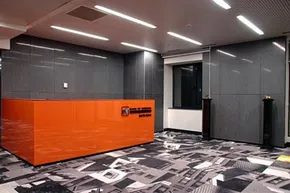
Bob Marley knew a thing or two about darkness. In “Concrete Jungle,” he sang about a life where the sun didn’t shine and the moon refused to play. His lyrics captured the grit of slum life and political strife, but there was one physical reality that even his optimism couldn’t fix: the lack of natural light in those dense, industrial spaces. For decades, concrete was the ultimate light blocker. It was strong. It was everywhere. It was also effectively a wall between you and the sky.
But the era of the dark gray block is ending.
A new material is turning the page. It’s not glass. It isn’t plaster. It’s concrete that lets light through. You might have seen panels in modern lobbies or artistic facades that look like stone but glow from within. This isn’t magic. It’s optical engineering.
What Is Translucent Concrete?
Let’s clear up a misconception immediately. Translucent concrete is not transparent. You cannot look through it and read a newspaper on the other side. It does not work like a window.
Instead, it works like a fiber optic cable.
The material relies on thousands of microscopic glass fibers embedded within the concrete matrix. These fibers act as light pipes. They capture ambient light—whether from the sun outside or lamps inside—and guide it through the block. The result is a surface that looks solid and opaque from one angle, but emits a soft, diffused glow from another.
The composition is specific. About 5% of the surface volume is made up of these optical fibers. The rest is standard concrete mix: cement, water, and sand. Because the fibers are distributed evenly, the structural integrity remains intact. You don’t lose the load-bearing capacity that makes concrete the backbone of modern construction. You just gain the ability to transmit light.
According to industry data, you can clearly see the outline of an object on the opposite side of the panel. Shadows are visible. Shapes are distinguishable. But details are lost in the diffusion. It’s privacy, illuminated.
The Origin of LiTraCon
While the concept of light-transmitting materials isn’t entirely new, the standardized, architectural-grade block is largely credited to Aron Losonczi.
Losonczi, a Hungarian architect, began developing these blocks in 2004, shortly after graduating from Budapest’s Technical University. He coined the term LiTraCon, short for Li ght Tra nsmitting Con crete.
The manufacturing process is precise. Large slabs are hand-molded in a factory. As the wet concrete is poured, thousands of optical fiber strands are embedded into it. The fibers are kept parallel, running straight through the block. This alignment is critical. If the fibers were tangled or angled randomly, the light would scatter too much, and the transmission effect would fail.
Once the concrete cures, the large slab is cut into individual blocks. The smallest standard size is about 48 by 14 inches (1.22 by 0.35 meters). The parallel fibers create a distinct visual texture. One side of the block appears bright where the light exits. The other side appears darker, where the light is still entering. This creates a dynamic surface that changes appearance depending on the light source.
Why Use It?
Concrete is dense. It’s heavy. It’s expensive to transport in large quantities if it’s solid. But translucent concrete adds a layer of aesthetic value that traditional materials can’t match.
In an office setting, it can reduce the need for artificial lighting during the day. Sunlight enters through one side, travels through the block, and illuminates the interior space. This isn’t just about looks. It’s about energy efficiency.
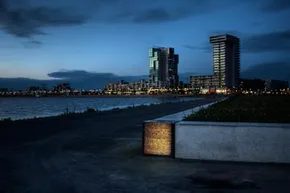

Concrete has a reputation problem. For decades, we’ve mixed it up with gloomy office buildings, bleak patios and cold, unfinished basements that make you want to leave. It is very heavy. It’s tough. It’s boring.
But what if the gray slab could glow?
Translucent concrete changes this narrative. By embedding light-transmitting fibers into the mixture, the material becomes more than just a structural barrier, but a source of ambient, open space. It feels fresh. It looks spacious. It no longer looks like a prison cell.
Of course there are catch. The glass and plastic fibers needed to pass light through the cement matrix drive up the cost. that price tag is still prohibitive for many large commercial projects. But despite the high cost, companies like LiTraCon and LUCEM are pushing the material into the wild. This is no longer just a curiosity in the laboratory. It can be found in public squares, banks and homes [sources: Inventables, Hanlon].
Where light and structure meet
Translucent Concrete is surprisingly versatile in its applications. It’s not just walls. Builders use it in partitions, stair treads, decorative tiles and even lighting fixtures. The goal is always the same. break up the gray monotony.
Take the public square in Stockholm, Sweden. One of the earliest public uses of this material. During the day, the pavement looks like ordinary concrete. You wouldn’t blink twice. But at night? The colored lights buried under the surface passes through the material. The ground itself becomes a lamp. It changes the entire atmosphere of the whole space [sources: Inventables, Portland Cement Association].
In Eastern Europe, the renovated Bank of Georgia headquarters made a bolder statement. They installed nearly 300 square meters (3,229 square feet) of translucent concrete panels manufactured by the German company LUCEM. These are more than just slabs. These are LED-lit wall panels that turn the building’s interior into something closer to a gallery than a bank [sources: Lucem, Kim].
Concrete That Moves
Translucent concrete isn’t the only innovation shaking up the industry. We used to think of concrete as static. Brittle. If it cracked, it stayed cracked.
That changed in 2005. Michigan’s Department of Transportation tested \ The result was startling. This reinforced material contains coated fibers that slide within the cement matrix. 彼らはストレスを吸収します。 構造が壊れるのではなく、曲がることができます。
スペックは印象的です。 このバージョンの曲げ可能なコンクリート は、従来の混合物よりもひび割れに対する耐性が 500 倍優れています。 また、約40パーセントも軽くなりました。 インフラストラクチャにとって、これは耐用年数が長くなり、メンテナンスが軽減されることを意味します。
次に、「自己強化」コンクリートの概念があります。 このバリアントでは、単に亀裂に抵抗するのではなく、鋼繊維を使用して亀裂が形成されるときにそれを橋渡しします。 素材は自らの傷を塞ぐために積極的に働きます。 統一というよりは癒し[出典: ハンロン、ラオ]。
材料的新时代
混凝土曾经是一匹只会一招的小马。 倒吧。 让它变硬。 祈祷它不会破裂。
现在,它弯曲了。 它可以治愈。 它让光线透过。
该材料正在蜕皮。 它变得反应灵敏。 适应性强。 以我们认为沙子、水和水泥的混合物不可能实现的方式生存。 我们仍在寻找使用它的最佳方法。 成本是


